Where Should Radon Be Tested in Your Home? | DezAir - Copy
Where in Your Home Should Radon Be Tested?
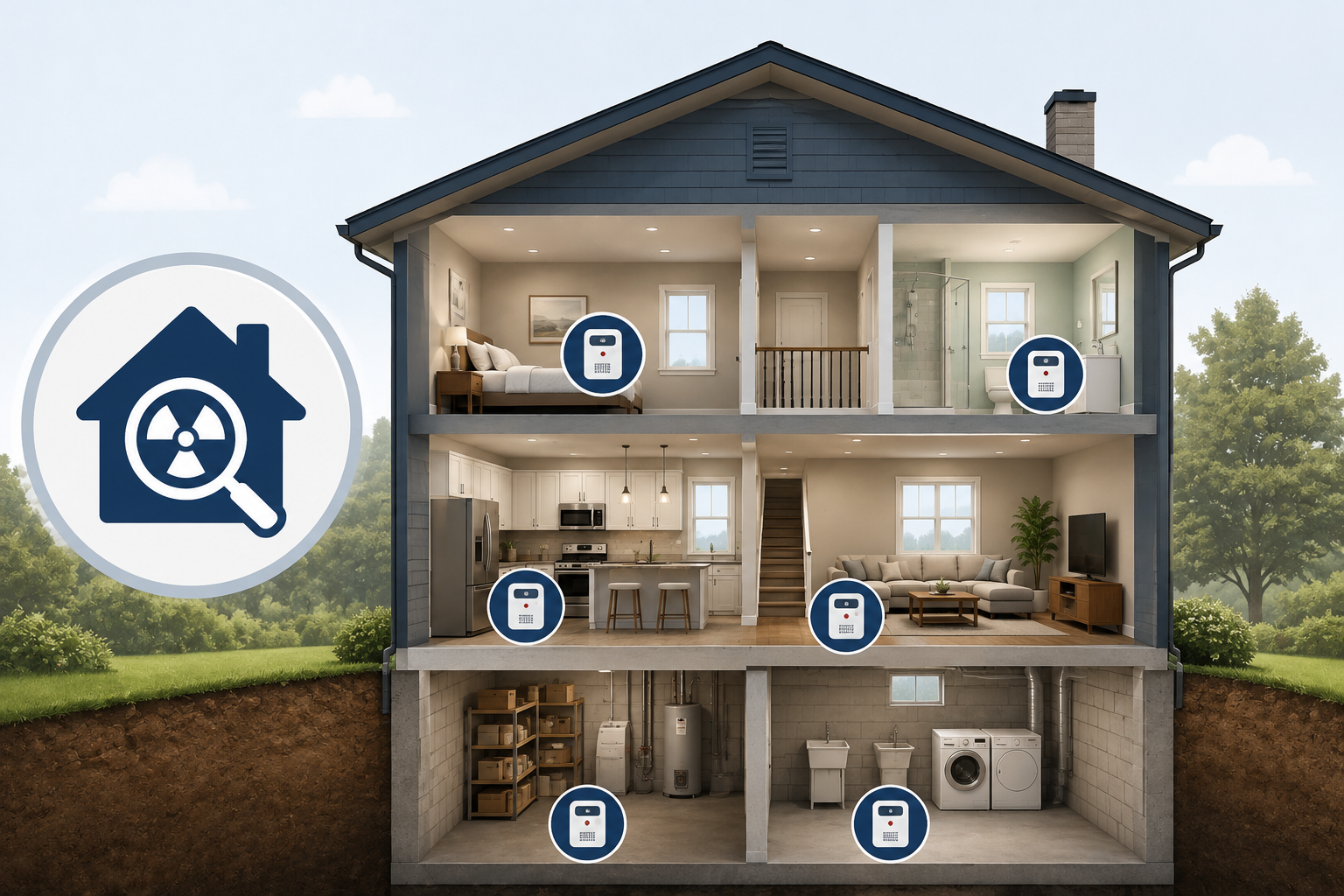
Radon monitors are typically placed at the lowest livable level of a home — meaning the lowest floor that's regularly occupied or could reasonably be occupied, not necessarily the absolute lowest point of the structure.
For most homes, that's a basement (finished or unfinished, if it's used as living space) or, for homes without a basement, the ground floor.
Why the Lowest Livable Level Matters
The reasoning is straightforward: radon enters through foundation-level openings — cracks, gaps around pipes, sump pits — and tends to be most concentrated close to its entry point before it disperses upward through the rest of the home.
Testing at the lowest livable level captures the area where levels are typically highest, giving a conservative, representative reading of what occupants in that space are actually exposed to.
Homes With Multiple Foundation Types
For homes with multiple foundation types (a partial basement plus a slab-on-grade addition, for example), more than one monitor may be needed, since radon entry and concentration can vary meaningfully between different foundation sections of the same home.
This is part of why monitor count is based on foundation type as well as square footage, not square footage alone.
Professional Monitor Placement
Your technician determines exact placement during the on-site visit, based on your home's specific layout and construction.
General guidance is a starting point, but the right location for your property depends on its actual foundation configuration.
Schedule a radon or mold test today with DezAir Quality Testing online at dezairqualitytesting.com.
